
Analog.
Retrotopia Now!

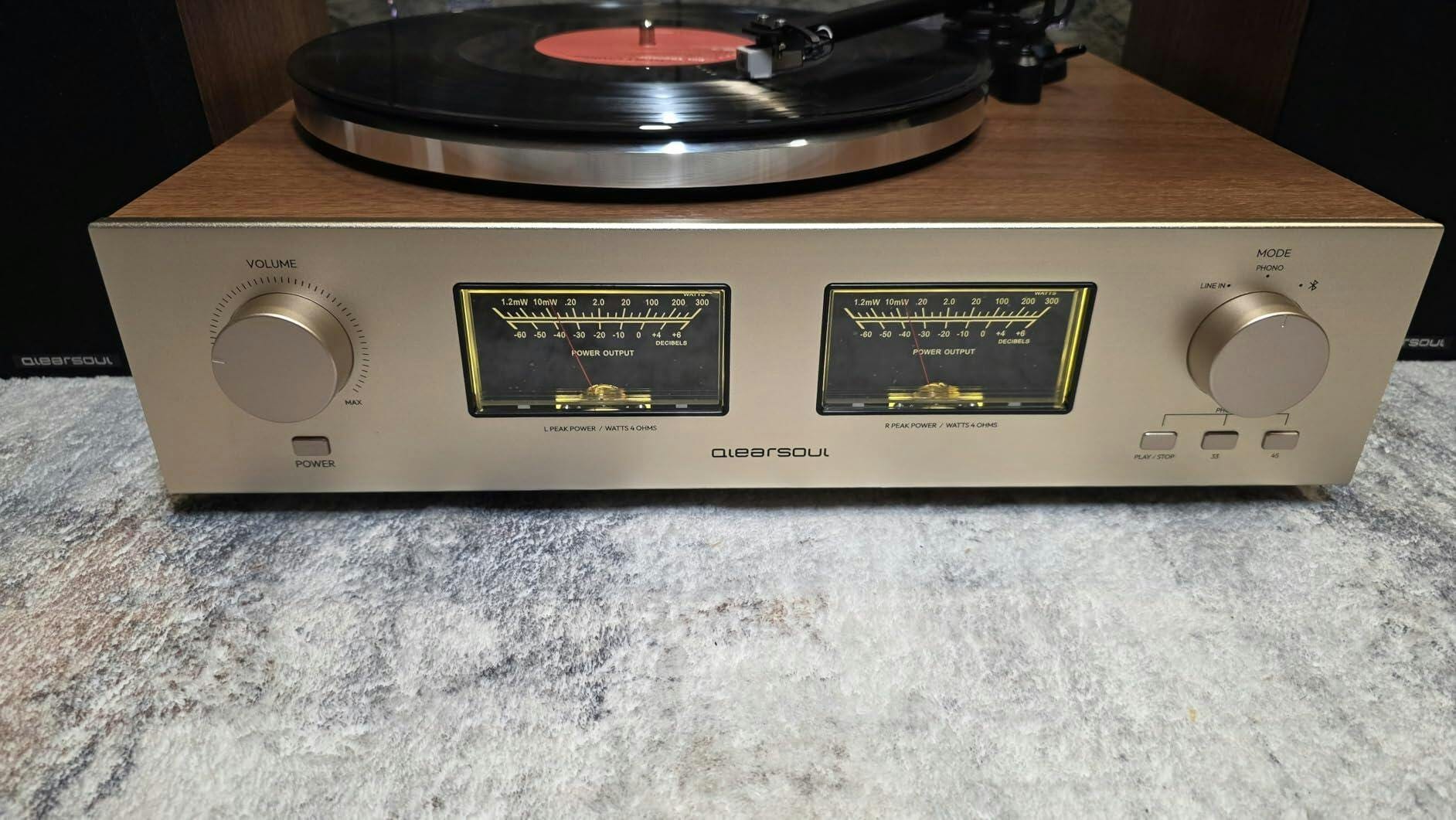
My turntable arrived today.
I feel this is a major marker in my life.
I’m cheap, so why pay good money for a device (one that doesn’t do 1001 other jobs) that you then have to go out and pay more money to buy things to play on that device when everything ever recorded is available online for free or for the monthly subscription I am also paying?
I hope not just because I’m bougie or audio-elitist. I am susceptible to both of those maladies, but I try to repent when I catch myself being tempted. It’s basically because, though I listen to a ton of music and enjoy being able to find everything I want online, I’ve come to believe my practice of listening is not what it should be.
One of my initial acquisitions.
The Turntable
Unlike phones and computers, turntables are designed to do basically just one job. Further, they have various components: tonearm, platter, input and output fixtures, preamps, various meters and other features (to be honest, I don’t know what half of these are), and then the speakers, etc…. I went with a setup that is all wired: no Bluetooth speakers- all analogue, no digital condensing. Supposedly what audiophiles like about vinyl is it has the fullest and warmest tonality as nothing is lost in the process of digitization. Further, all the streaming services condense the music even further to save on server space.
I probably ended up with a not very good set (I know it isn’t the sort of deal people spend thousands of dollars on), but I did some research and made the choice after a process of thought (and after getting the okie dokie from my friend of infinite musical knowledge, Jay).
Initial acquisition.
So, before you even get to think about playing any music, you have to consider and make decisions. That’s sort of how things should be. What do I wish to accomplish here? What is the best way of going about that in the given circumstances (budget, etc…)? Probably there is no harm done by downloading a music app on your phone and just going for it. But there are things that are best thought about, and we are encouraged to live all of life as if it were an app (or simply to live it solely on apps).
The Record Store
As soon as I got the system set up, I had to run out to a record store because I just had to hear how it sounded.
I had not shopped for records since the 80s (though I had shopped for CDs as recently as the 00s I suppose). I love and had missed record stores.
First, there are other people there shopping for records as well. You do it together. You might even talk to them about what they are into. That never happens when I’m choosing which algorithmic mix to choose on Spotify. Further, there are folks who work in the record store who tend to be into music: EXPERTS (the actual kind, not the kind who propagandize THE science) right there!
Initial acquisition.
Second, it takes a bit of work and time to get there and then you have to thumb through the stacks. Another opportunity for thought and intention. Also, they don’t have everything. In fact, they have barely anything, all things considered. You have to learn to value what is available.
Third, there are finds. On my first trip (in this portion of my life) to the record store, I picked up things by Sonny Rollins, Muddy Waters, Pete Seeger, Odeta, Ian and Silvia, Peter, Paul and Mary, Roy Orbison, Mahalia Jackson, Stan Rogers, and Steeleye Span. Many were $1 or $2 because no one listens to good music, despite my best efforts. I had to pay $20 for the Rollins and Muddy and pass on the $25 BB King Live in Cook County Jail (though it was probably the most important recording in the little shop’s bins).
But the find was Ray Wylie Hubbard’s Co-Starring Too, a relatively recent release, that goes for $20 and up on ebay, for a mere $8. There is joy in making the find. A joy that eludes us when we are saturated with media.
The Cover
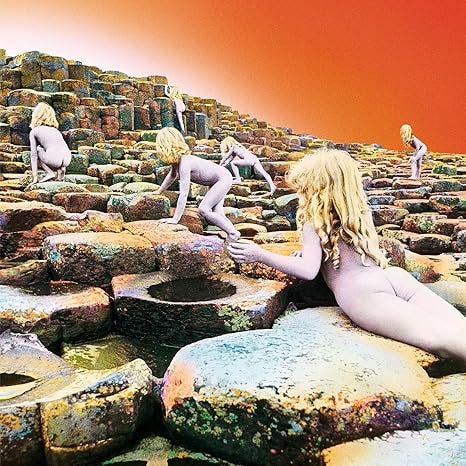
Now we actually have some recorded music and a device to play it on. As we settle in (and settling in is a good preamble to listening to music; my ritual will often include preparing a glass of wine), we pick up the album and look at the cover.
We contemplate it. This is comprised mostly of images. This is the realm of art and mythos if people have done their jobs right.
The Liner Notes
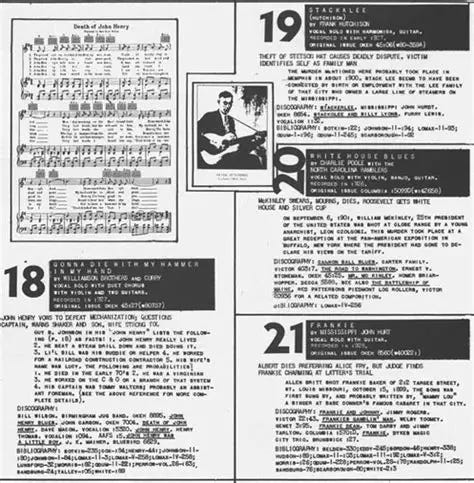
Then we read the liner notes. Reading before listening to the tunage?? Here we find out about the artist, the conceptualization of the album, who all is playing on each song, and things like that. I have no idea why the streaming services don’t include a way to pull up the liner notes. Just literacyphobia I guess. This is the realm of the logos; what helps us make sense of what is going on with the music.
The Music
Then we listen to the music. Where mythos and logos, meaning and structure, melody and rhythm all come together.
Initial acquisition. The full album is not available on Youtube.
When one listens to an album, beginning to end, one is listening to a whole work. This takes patience.
In Philosophy at 33 1/2 RPM (the speed at which an LP record rotates), James Harris goes on at length about how revolutionary the emergence of the album (vs. singles; 78 rpm) was. This technology allowed artists the audio space to develop complexity in their music and the themes it addressed. Here, music could become philosophy.
And then we lost it. It went away. Music is just stupid again.
Example of pre-album pop lyrics:
Louie Louie, oh no, you take me where ya gotta go
Yeah, yeah, yeah, yeah, yeah, baby
Louie Louie, oh baby, take me where ya gotta go
I know, I know, it’s someone’s favorite lyric and it’s the music and spirit that carry the meaning. Yadda, yadda, yadda. No doubt pop music is much more cerebral now with major political messages like singing about our phalluses in Spanish or cultural manifestos manifested as twerking in some new way (how many ways can there be really?).
Here, with the depth afforded by the classic album, is what I wanted to get back! The slow, comprehensive, meditative, listening to a work of musical art.
Initial acquisition.
This allows for and facilitates attention. Paying genuine attention is extremely countercultural these days.
Retro
I guess I’m now retro (in yet one more way).
In Retrotopia, John Michael Greer presents a picture of a fragmented post-civil war America, circa 2065 (I don’t think it will take that long, and let’s get on with some fragmenting/localizing). In The Lakeland Republic, the region around the Great Lakes, the society has engaged in intentional technological retrogression, settling on the 1950s as the best time period.
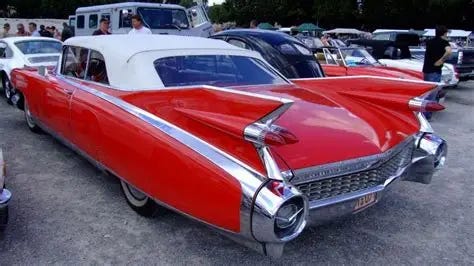
I’m not sure that is the best choice, but you’re pre-digital and you have rock-and-roll and tailfins, so pretty good for sure.
This is our destiny if we are to remain human. We must regress. That is not nostalgia nor romanticism. It is good hardheaded realism, old-fashioned American paranoia about liberty preservation, and Amish common sensism.
I’m not going to stop listing to the world’s wealth of music on Spotify nor searching out obscure documentaries on American roots music on Youtube. I am, however, going to devote an increasing amount of my time to slowing down and meditatively listening to works of art in glorious analog.
Our humanity is analog, with all the scratches included. But with the full, unadulterated warmth as well.
The future is history, baby!
Yes. Analog is called that because it presents the true wave form which digital inherently does not because digital operates in a binary way. Think of the smoothness of a sine wave. Compare it to the saw-toothed digital ‘wave’ - - steps (no matter how tiny) are not smooth. This is how i understand why analog has a richer sound.
“Supposedly what audiophiles like about vinyl is it has the fullest and warmest tonality as nothing is lost in the process of digitization. “
Record stores are still the best places for music discovery. They play cool stuff. People within earshot talk about cool stuff. You’ll see album art that piques your interest, or be reminded about albums you still need to listen to. You can even ask the workers point blank for recommendations and they will light up. It’s paradise!