
Was Marx a Satanist?
Jordan Peterson’s Achille’s Heel, Nineteenth Century Radicals’ Satan Problem, and Anarchism’s Fatal Flaw

I actually tend to like Jordan Peterson.
However, a recent snippet of an interview he did with did with Paul Kengor reminded me of his Achilles’ Heel. The interview was about Karl Marx’s supposed Satanism.
I admire Peterson for his ability to bring together Jungian psychoanalysis, philosophy of religion, neuroscience, Darwinian evolution, and some literature, mainly Solzhenitsyn and Dostoyevsky. That is an impressive feat. Also, I believe that he genuinely intends to provide helpful guidance to young people and largely has.
However, he seems to have taken as his primary enemy what he likes to term ‘cultural Marxism.’ Now, what he means to point to by that is fully worthy of critique and I have offered an example of that. However, what is clear is that Peterson understands neither Marx nor the later Marxist and other Critical Theorists behind what he intends to criticize. This is obvious in almost every comment he makes on the topic but was painfully so when he showed up to debate Slavoj Zizek in 2019, apparently (by his own account during the debate) having read mainly only The Communist Manifesto on which to base his characterization of Marxism.
While famous, this is among the least philosophically developed of Marx’s (and his co-writer Engels’s) writings, being a political pamphlet, not an actual book. Fortunately for Peterson, Zizek showed up more interested in finding their common ground than in pulverizing Peterson.
I say the above mentioned interview reminded me of this flaw. Other than innuendo, ad hominems, and extremely weak inferences, they never actually get around to talking about that. However, there is a real issue here which I intend to explore.
19th Century radicalism and Satan
There was an effort in nineteenth century radical and romantic circles to rehabilitate the image of Satan. This is clearly there and not some great discovery.
Behind this lay the picture of Satan developed by John Milton in Paradise Lost (1667). Milton was surely a Christian, if not an overly orthodox one. Yet one senses that he feels some sympathy for Satan. Satan is the archetype of the ‘rebel’ and Milton had supported the rebel Parliamentarians in the English Civil War (who were largely, like Oliver Cromwell, Puritans and Calvinists).
Satan gets pretty much the best line in the epic poem: “Better to reign in hell than serve in heaven.” It is a tragic line and in being able to see Satan as a tragic figure, rather than simply an evil one, Milton gave depth to his literary character. There is something of the eternal quest for liberty and dignity in Satan’s proclamation. Yet, Satan is hopelessly mistaken in his estimation of things. Metaphysically, within the context of Paradise Lost, Satan is not his own master- he did not create himself. God possesses irrefutably just authority (Latin auctoritas, which is also the root of our word ‘author’): God ‘wrote’ the world (as Shakespeare wrote Hamlet), so he gets to write what he wants (though that will not be arbitrary as God cannot act against the nature of God). The problem for Milton’s Satan comes down to will (self-determination) vs metaphysics (ultimate reality as given). This is also the problem of modernity.
As modernity developed and human beings gained more and more power over ‘nature,’ the idea that our fate (if not our origin) was in our own hands gained in popularity. Poets like Goethe and Shelley explored the themes of Prometheus (who steals fire from the gods for humankind) and Faust (the proverbial ‘Devil’s bargain:’ your soul for power). Eventually Nietzsche would sign some of his works “The Anti-Christ” (but also sign some “The Crucified One;” he was rather conflicted).
So, as nineteenth century radicalism developed, especially socialism and anarchism, it is somewhat natural that their proponents would see their liberatory projects, handing control of humanity’s fate over to humanity, not some elite, superstition, external authority, etc… in Promethean and Satanic terms. The latter could especially lend one a ‘bad boy’ (or actually quite often, ‘bad girl’) aura of radicalness and coolness. There is a long tradition of radicals adopting Satan as a sort of rebel icon.
This literary rehabilitation of Satan then went on, in the twentieth century, to impact the development of actual modern religious Satanism. We can see this reflected, for instance, in the (in)famous statue of Baphomet lending benevolent guidance to two small children (a bit creepy, I’m sorry).
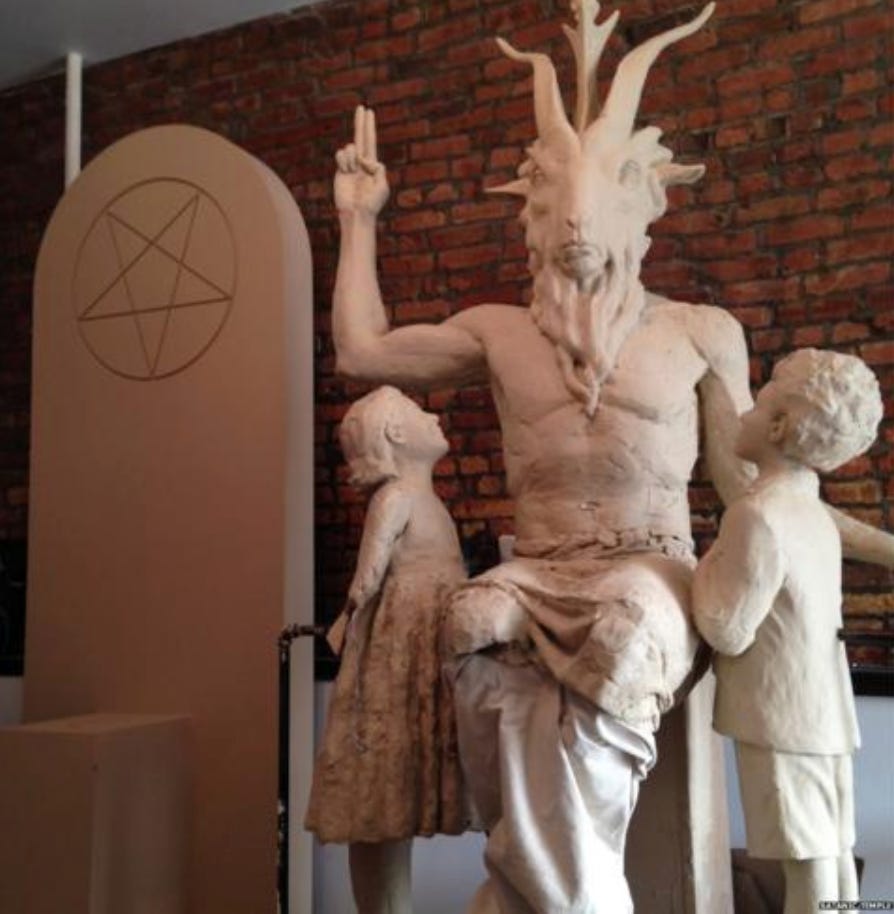
Here Satan is portrayed as benefactor, educator, and rather nice guy (Baphomet is actually a hermaphrodite, but Satanic Temple folks decided to play that down as having the children staring at his breasts could be a “distraction”). The statue toured a number of state capital buildings and now, I believe, resides in an art museum in Salem, Massachusetts (you know, of the seventeenth century witch trials- see who has the last laugh).
Getting down to metaphysical brass tax
Though Marx has lately drawn the most attention from critics in this regard, his published works contain very little use of this literary device. He played around with it more in some of his early unpublished works. Also, to an extent, Marx retains a more robust metaphysics than perhaps he meant to. The structure is still basically Hegelian and the content largely Aristotelian. So, I think the case against Marx is relatively weak (you can make all sorts of other cases against him if you like).
I’ll choose as my illustration (and there could have been many) Mikhail Bakunin. I do this for several reasons. One, he seems to slip under the radar a bit, but is very explicit in his literary ‘Satanism.’ Further, he may be more central to the thought of this audience, so grappling with him is important. Finally, he helps us see what I think is a central issue within the anarchist tradition.
Some anarchists like to say ‘no Gods, no masters.’ I think at least the basic idea of that traces back to Bakunin. For the sake of this essay, I’ll limit myself to passages from his God and the State (Dover, 1970). There he writes:
“Satan, the eternal rebel, the first freethinker and the emancipator of worlds. He makes man ashamed of his bestial ignorance and obedience [referencing the ‘serpent’ in the Garden of Eden]; he emancipates him, stamps upon his brow the seal of liberty and humanity, in urging him to disobey and eat of the fruit of knowledge” (p. 10).
He calls God into the Dock to testify to Satan’s truthfulness and aid to humanity (pp. 11-12). The rest of the book is a sustained attack on God, theism, and metaphysics from Plato forward (p. 15, 73).
Does this make Bakunin a ‘Satanist?’ If by that you mean did he sacrifice children, celebrate Black Masses with menstrual blood, or listen to Death Metal (just joking), then probably not. His explicit invocation of Satan seems to (almost) be merely hyperbolic, clever, iconoclastic, etc…. That is, rather adolescent, but mostly harmless.
However, I think there is a real problem in Bakunin. His animus is mainly turned against States and Churches. Fine, plenty to criticize there. He lands some good punches. However, he gets the deeper picture and he means to do a thorough job.
He perceives that most actual States and Churches have based their claims to authority on an underlying theistic or metaphysical authority. He intends to undermine that as well, with the only authority left being “science” (p. 60).
Let’s think of it this way. Let’s say there is a metaphysically well-grounded conception of the Good. In that case various institutions could lay their claims to authority by saying that their foundation is built on that conception or in their promotion of the Good. Further, if there is a metaphysical Good, humanity is not absolutely free morally and existentially. There can be no moral claim against the Good. There is a metaphysical constraint on the will.
Now, I think there are two basic options any rebel, radical, resister, etc… might take against the tyrannic institutions of any given day vis a vis metaphysics. (1) They can base their critique of the institutions in their metaphysics. Institution A is illegitimate, tyrannical, or evil because it violates the metaphysical good: it is unjust. Or (2) they can seek to undermine all institutions and oppression at one go by denying the existence of a well-grounded metaphysical Good, hence undercutting the authoritative moral claims of all institutions in one go.
Bakunin is clear that his project is to implement option (2). Get the job done once and for all. Also, not only are we then left free of limits on our liberty by States and Churches, we are also free of metaphysical constraint. Free free. Sartrean existentialist free.
The fatal flaw of ‘anarchism’
The problem is immediately clear. If I have no well-grounded metaphysical conception of the Good, I have no moral basis to critique States, Churches, or anything else. I have only my preferences and indignant rage, at which Bakunin excels (and he is enjoyable to read for that very reason): my moral critique boils down to ‘I don’t like it, dammit!’ ‘Don’t get it? I can yell it louder!’
Further, the problem is bigger than just Bakunin. The very name ‘anarchism,’ coined by Pierre-Joseph Proudhon, suggests that it is, per se, committed to a position something like this.
Arche, in classical Greek, means both ‘to begin’ and ‘to govern’. It refers to the fundamental principle or substance that is the ground of all things. Hence, it is the meta- metaphysics. It is the ‘beginning’ of all cosmic and natural order.
Now, I think Proudhon (though he played around with the Satan talk as well) rather carelessly adopted the term and negated it simply to mean ‘anti-(political) government’. Bakunin, I think, understands the whole picture and wants to deny not only the authority of government, but any metaphysical basis of authority.
There are two problems with this, one existential and one more specifically related to anarchism.
Existentially, the denial of any basis of cosmic or natural order quickly devolves into ‘nihilism,’ the denial of any metaphysical truth, morality, or meaning. Some Russian anarchists were quite explicitly nihilists. If you go that route, why get out of the friggin’ bed in the morning? This represents rebellion against Nature and Being. That was Satan’s error.
The metaphysical turn
The other problem is an internal problem to anarchist theory. If the idea is that human beings don’t need the external, oppressive, organization imposed by the State, there needs to be some inherent, natural, principle of good order that can undergird a trust in ‘spontaneous’ order. All the classical anarchists tend to assume this, but have difficulty convincingly explaining it.
As a distinctly modern political theory, anarchism has exhibited the same reluctance to embrace a substantive metaphysics as most modern system of thought. Eager to avoid falling into patterns of thought which could limit individual and social autonomy, it has been more reluctant than most.
However, this problem is solved if we distinguish Natural metaphysical order from State order. If there is a Natural basis for order, then ‘spontaneous’ (or ‘natural’) order can be theorized. Further, it’s going to undergird a metaphysical conception of the Good which can be used to meaningfully critique all the non-Good institutions you like. If you can thread that needle, you get to have your cake and to eat it too. This overcomes anarchism’s ‘fatal flaw.’ Anarchism needs metaphysics to be internally coherent.
This is, as I see it, the theoretical task taken up by the likes of Paul Cudenec and Crow Qu’appelle. This is what constitutes ‘Organic Radicalism’ and ‘Anarcho-perennialism,’ their respective terms for a theory that has made the metaphysical turn.
This constitutes an anti-Satanic, a.k.a anti-nihilist anarchism. That’s probably better.
This essay was first published on Nevermore Media
I tried to read The Devil and Karl Marx bit found it unnecessarily polemical. It also assumed all readers were catholic. It was disappointing, as I would liked to have seen this topic dealt with in a much more robust way.
What you say about the Roman empire being a "real Satanic force" is my main concern: that the modern day inheritors of imperialism, and their hidden, behind the state actors, are truly satanic=amoral.